Assistant Professor
Universidade da Beira Interior
Nuno holds a Ph.D. in Computer Science and Engineering. His current research interests include: information systems (with special focus on clinical decision support systems), data fusion, artificial intelligence, and software. He is the coordinator of the Ambient Living Computing and Telecommunication Laboratory (ALLAB) at UBI. He is also member of BSAFE Lab, and Instituto de Telecomunicações - IT at UBI.
He has around 60 scientific publications including book chapters, conference proceedings, and full-paper journals; e.g. IEEE Access, Applied Soft Computing, Artificial Intelligence in Medicine, Computer Methods and Programs in Biomedicine, Pervasive and Mobile Computing, and Measurement, just to mention a few. He has strong experience in R&D and cooperation at European level projects with both academia and industry.

Universidade da Beira Interior
Universidade Lusófona de Humanidades e Tecnologias
Universidade da Beira Interior
EU Master Care and Technology, UBI (Portugal), Zuyd, Fontys, Saxion (The Netherlands), SAMK, and TAMK (Finland)
Universidade da Beira Interior
in several national and international companies
ASSEC - Sistemas de Informação e Multimédia
Integer SGPS
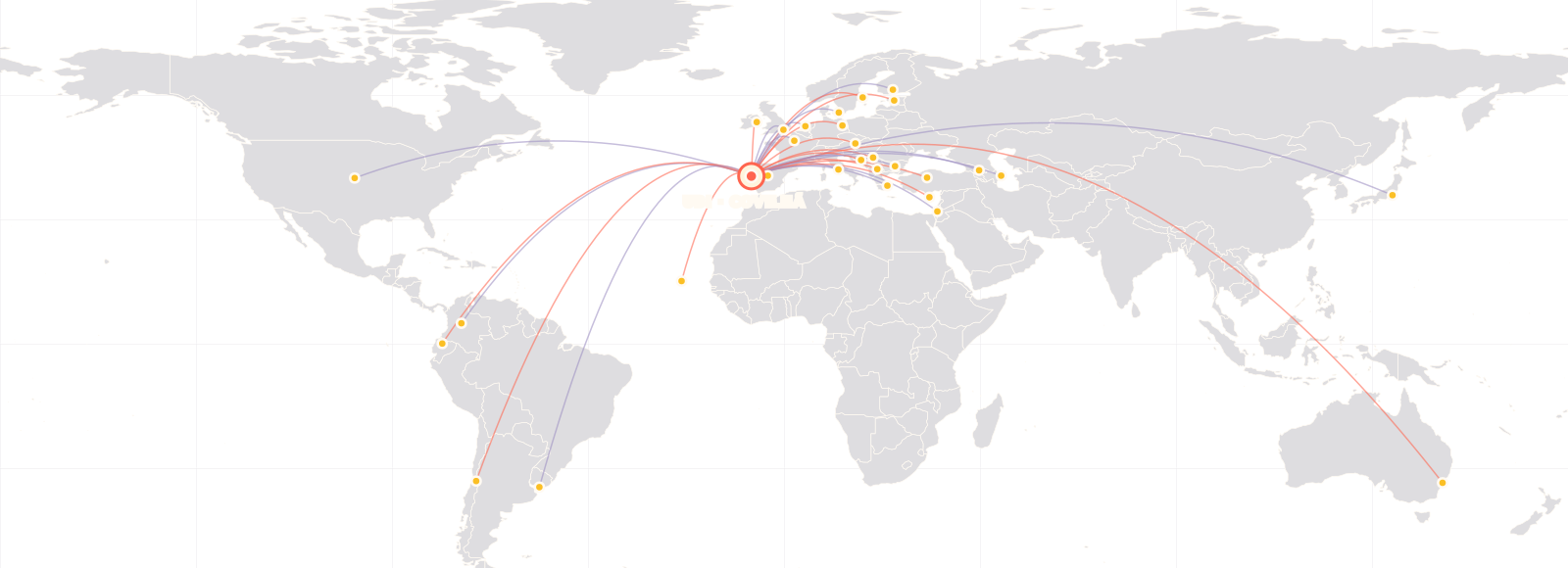
Stemming from an active and steady participation at the international level projects such as the Algorithms, Architectures and Platforms for Enhanced Living Environments (AAPELE), and the European Cooperation for Statistics of Network Data Science (COSTNET), my publications are the ultimate outcome of an intense and fruitful cooperation with top researchers and high ranked universities. This international exposure has been formative and character building in my research career.
A wise feature selection from minute-to-minute Electrocardiogram (ECG) signal is a challenging task for many reasons, but mostly because of the promise of the accurate detection of clinical disorders, such as the sleep apnea. In this study, the ECG signal was modeled in order to obtain the Heart Rate Variability (HRV) and the ECG-Derived Respiration (EDR). Selected features techniques were used for benchmark with different classifiers such as Artificial Neural Networks (ANN) and Support Vector Machine(SVM), among others. The results evidence that the best accuracy was 82.12%, with a sensitivity and specificity of 88.41% and 72.29%, respectively. In addition, experiments revealed that a wise feature selection may improve the system accuracy. Therefore, the proposed model revealed to be reliable and simpler alternative to classical solutions for the sleep apnea detection, for example the ones based on the Polysomnography.
Departing from the well-known problem of the excessive overhead and latency of connection oriented protocols, this paper describes a new almost reliable connectionless protocol that uses user datagram protocol (UDP) segment format and is UDP compatible. The problem is presented and described, the motivation, the possible areas of interest and the concept and base operation modes for the protocol named keyed UDP are presented (here called KUDP). Also, discussed are some of the possible manners in which the KUDP can be used, addressing potential problems related with current networking technologies. As UDP is a connectionless protocol, and KUDP allows for some degree of detection of loss and re-ordering of segments received out-of-sequence, we also present a proposal for a stream reconstruction algorithm. This paper ends by mentioning some of the research issues that still need to be addressed.
Several types of sensors have been available in off-the-shelf mobile devices, including motion, magnetic, vision, acoustic, and location sensors. This paper focuses on the fusion of the data acquired from motion and magnetic sensors, i.e., accelerometer, gyroscope and magnetometer sensors, for the recognition of Activities of Daily Living (ADL). Based on pattern recognition techniques, the system developed in this study includes data acquisition, data processing, data fusion, and classification methods like Artificial Neural Networks (ANN). Multiple settings of the ANN were implemented and evaluated in which the best accuracy obtained, with Deep Neural Networks (DNN), was 89.51%. This novel approach applies L2 regularization and normalization techniques on the sensors’ data proved it suitability and reliability for the ADL recognition.
(to appear)
Sensors available on mobile devices allow the automatic identification of Activities of Daily Living (ADL). This paper describes an approach for the creation of a framework for the identification of ADL, taking into account several concepts, including data acquisition, data processing, data fusion, and pattern recognition. These concepts can be mapped onto different modules of the framework. The proposed framework should perform the identification of ADL without Internet connection, performing these tasks locally on the mobile device, taking in account the hardware and software limitations of these devices. The main purpose of this paper is to present a new approach for the creation of a framework for the recognition of ADL, analyzing the allowed sensors available in the mobile devices, and the existing methods available in the literature.
An increase in the accuracy of identification of Activities of Daily Living (ADL) is very important for different goals of Enhanced Living Environments and for Ambient Assisted Living (AAL) tasks. This increase may be achieved through identification of the surrounding environment. Although this is usually used to identify the location, ADL recognition can be improved with the identification of the sound in that particular environment. This paper reviews audio fingerprinting techniques that can be used with the acoustic data acquired from mobile devices. A comprehensive literature search was conducted in order to identify relevant English language works aimed at the identification of the environment of ADLs using data acquired with mobile devices, published between 2002 and 2017. In total, 40 studies were analyzed and selected from 115 citations. The results highlight several audio fingerprinting techniques, including Modified discrete cosine transform (MDCT), Mel-frequency cepstrum coefficients (MFCC), Principal Component Analysis (PCA), Fast Fourier Transform (FFT), Gaussian mixture models (GMM), likelihood estimation, logarithmic moduled complex lapped transform (LMCLT), support vector machine (SVM), constant Q transform (CQT), symmetric pairwise boosting (SPB), Philips robust hash (PRH), linear discriminant analysis (LDA) and discrete cosine transform (DCT).
Ambient-assisted living (AAL) is promising to become a supplement of the current care models, providing enhanced living experience to people within context-aware homes and smart environments. Activity recognition based on sensory data in AAL systems is an important task because 1) it can be used for estimation of levels of physical activity, 2) it can lead to detecting changes of daily patterns that may indicate an emerging medical condition, or 3) it can be used for detection of accidents and emergencies. To be accepted, AAL systems must be affordable while providing reliable performance. These two factors hugely depend on optimizing the number of utilized sensors and extracting robust features from them. This paper proposes a generic feature engineering method for selecting robust features from a variety of sensors, which can be used for generating reliable classification models. From the originally recorded time series and some newly generated time series [i.e., magnitudes, first derivatives, delta series, and fast Fourier transformation (FFT)-based series], a variety of time and frequency domain features are extracted. Then, using two-phase feature selection, the number of generated features is greatly reduced. Finally, different classification models are trained and evaluated on an independent test set. The proposed method was evaluated on five publicly available data sets, and on all of them, it yielded better accuracy than when using hand-tailored features. The benefits of the proposed systematic feature engineering method are quickly discovering good feature sets for any given task than manually finding ones suitable for a particular task, selecting a small feature set that outperforms manually determined features in both execution time and accuracy, and identification of relevant sensor types and body locations automatically. Ultimately, the proposed method could reduce the cost of AAL systems by facilitating execution of algorithms on devices with limited resources and by using as few sensors as possible.
Background and objective: Sleep apnea syndrome (SAS), which can significantly decrease the quality of life is associated with a major risk factor of health implications such as increased cardiovascular disease, sudden death, depression, irritability, hypertension, and learning difficulties. Thus, it is relevant and timely to present a systematic review describing significant applications in the framework of computational intelligence-based SAS, including its performance, beneficial and challenging effects, and modeling for the decision-making on multiple scenarios. Methods: This study aims to systematically review the literature on systems for the detection and/or prediction of apnea events using a classification model. Results: Forty-five included studies revealed a combination of classification techniques for the diagnosis of apnea, such as threshold-based (14.75%) and machine learning (ML) models (85.25%). In addition, the ML models, were clustered in a mind map, include neural networks (44.26%), regression (4.91%), instance-based (11.47%), Bayesian algorithms (1.63%), reinforcement learning (4.91%), dimensionality reduction (8.19%), ensemble learning (6.55%), and decision trees (3.27%). Conclusions: A classification model should provide an auto-adaptive and no external-human action dependency. In addition, the accuracy of the classification models is related with the effective features selection. New high-quality studies based on randomized controlled trials and validation of models using a large and multiple sample of data are recommended.
Mobile applications have become a must in every user’s smart device, and many of these applications make use of the device sensors’ to achieve its goal. Nevertheless, it remains fairly unknown to the user to which extent the data the applications use can be relied upon and, therefore, to which extent the output of a given application is trustworthy or not. To help developers and researchers and to provide a common ground of data validation algorithms and techniques, this paper presents a review of the most commonly used data validation algorithms, along with its usage scenarios, and proposes a classification for these algorithms. This paper also discusses the process of achieving statistical significance and trust for the desired output.
The self-reporting of pain complaints is considered the most accurate pain assessment method and represents a valuable source of data to computerised clinical decision support systems (CCDSS) for pain management. However, the subjectivity and variability of pain conditions, combined with missing data, are constraints on the usefulness and accuracy of CCDSS. Based on data imputation principles, together with several mathematical models, this paper presents a CCDSS, the Patient Oriented Method of Pain Evaluation System (POMPES), that produces tailored alarms, reports, and clinical guidance based on collected patient-reported data. This system was tested using clinical data collected during a six-week randomised controlled trial involving thirty-two volunteers recruited from an ambulatory surgery department. The decisions resulting from the POMPES were fully accurate when compared with clinical advice, which proves the ability of the system to cope with missing data and detect either stability or changes in the self-reporting of pain.
Background: Mobile and web technologies are becoming increasingly used to support the treatment of chronic pain conditions. However, the subjectivity of pain perception makes its management and evaluation very difficult. Pain treatment requires a multi-dimensional approach (e.g., sensory, affective, cognitive) whence the evidence of technology effects across dimensions is lacking. This study aims to describe computerised monitoring systems and to suggest a methodology, based on statistical analysis, to evaluate their effects on pain assessment. Methods: We conducted a review of the English-language literature about computerised systems related to chronic pain complaints that included data collected via mobile devices or Internet, published since 2000 in three relevant bibliographical databases such as BioMed Central, PubMed Central and ScienceDirect. The extracted data include: objective and duration of the study, age and condition of the participants, and type of collected information (e.g., questionnaires, scales). Results: Sixty-two studies were included, encompassing 13,338 participants. A total of 50 (81%) studies related to mobile systems, and 12 (19%) related to web-based systems. Technology and pen-and-paper approaches presented equivalent outcomes related with pain intensity. Conclusions: The adoption of technology was revealed as accurate and feasible as pen-and-paper methods. The proposed assessment model based on data fusion combined with a qualitative assessment method was revealed to be suitable. Data integration raises several concerns and challenges to the design, development and application of monitoring systems applied to pain.
This paper focuses on the research on the state of the art for sensor fusion techniques, applied to the sensors embedded in mobile devices, as a means to help identify the mobile device user’s daily activities. Sensor data fusion techniques are used to consolidate the data collected from several sensors, increasing the reliability of the algorithms for the identification of the different activities. However, mobile devices have several constraints, e.g., low memory, low battery life and low processing power, and some data fusion techniques are not suited to this scenario. The main purpose of this paper is to present an overview of the state of the art to identify examples of sensor data fusion techniques that can be applied to the sensors available in mobile devices aiming to identify activities of daily living (ADLs).
Objective: The occurrence of pain accounts for billions of dollars in annual medical expenditures; loss of quality of life and decreased worker productivity contribute to indirect costs. As pain is highly subjective, clinical decision support systems (CDSSs) can be critical for improving the accuracy of pain assessment and offering better support for clinical decision-making. This review is focused on computer technologies for pain management that allow CDSSs to obtain knowledge from the clinical data produced by either patients or health care professionals. Methods and materials: A comprehensive literature search was conducted in several electronic databases to identify relevant articles focused on computerised systems that constituted CDSSs and include data or results related to pain symptoms from patients with acute or chronic pain, published between 1992 and 2011 in the English language. In total, thirty-nine studies were analysed; thirty-two were selected from 1245 citations, and seven were obtained from reference tracking. Results: The results highlighted the following clusters of computer technologies: rule-based algorithms, artificial neural networks, nonstandard set theory, and statistical learning algorithms. In addition, several methodologies were found for content processing such as terminologies, questionnaires, and scores. The median accuracy ranged from 53% to 87.5%. Conclusions: Computer technologies that have been applied in CDSSs are important but not determinant in improving the systems’ accuracy and the clinical practice, as evidenced by the moderate correlation among the studies. However, these systems play an important role in the design of computerised systems oriented to a patient's symptoms as is required for pain management. Several limitations related to CDSSs were observed: the lack of integration with mobile devices, the reduced use of web-based interfaces, and scarce capabilities for data to be inserted by patients.
Millions of people around the world suffer from pain, acute or chronic and this raises the importance of its screening, assessment and treatment. Pain, is highly subjective and the use of clinical decision support systems (CDSSs) can play an important part in improving the accuracy of pain assessment, and lead to better clinical practices. This review examines CDSSs, in relation to computer technologies and was conducted with the following electronic databases: CiteSeerx, IEEE Xplore, ISI Web of Knowledge, Mendeley, Microsoft Academic Search, PubMed, Science Accelerator, Science.gov, ScienceDirect, SpringerLink, and The Cochrane Library. The studies referenced were compiled with several criteria in mind. Firstly, that they constituted a decision support system. Secondly, that study data included pain values or results based on the detection of pain. Thirdly, that they were published in English, between 1992 and 2011, and finally that they focused on patients with acute or chronic pain. In total, thirty-nine studies highlighted the following topics: rule based algorithms, artificial neural networks, rough and fuzzy sets, statistical learning algorithms, terminologies, questionnaires and scores. The median accuracy ranged from 53% to 87.5%. The lack of integration with mobile devices, the limited use of web-based interfaces and the scarcity of systems that allow for data to be inserted by patients were all limitations that were detected.
BACKGROUND: For economic reasons, i.e., to reduce costs of in-hospital patient accommodations, constant pressure has been applied in recent years to increase the percentage of ambulatory surgeries. Effective control of post-operative pain after ambulatory surgery is challenging to all health professionals. Computerised systems are being implemented more frequently for remote patient monitoring, including during the at-home post-operative period. OBJECTIVE: This study evaluates the feasibility of delivering a computerised system, developed in-house, for remote pain monitoring. It evaluates the user-friendliness of the system and the extent of patient compliance. Finally, a comparative assessment of the system is made with respect to the quality of pain treatment in ambulatory surgery. METHODS: The participants included 32 adults, aged 18–75, randomly assigned to a control group or to a computerised treatment group. The primary treatment outcome was measured by pain intensity ratings (0–10 NRS) reported several times per day during a five-day monitoring period, using an electronic pain diary combined with a web-based personal health record. RESULTS AND CONCLUSIONS: The findings demonstrated the feasibility and suitability of the proposed system for pain management. Its handling was user-friendly, without requiring advanced skill or prior experience. In addition, the results showed that the guidance of health care professionals is essential to patients' satisfaction and positive experience with the system. There were no significant group differences with respect to improvements in the quality of pain treatment; however, this can be explained by the low pain scores registered in both groups, related to the type of surgical interventions recruited and the degrees of pain that are easily treated. To evaluate the benefits from a patient-centred perspective, studies of major ambulatory surgeries or of patients in chronic pain, including oncologic and non-oncologic pain resistant to treatment, are necessary.
In recent years, Internet-delivered treatments have been largely used for pain monitoring, offering healthcare professionals and patients the ability to interact anywhere and at any time. Electronic diaries have been increasingly adopted as the preferred methodology to collect data related to pain intensity and symptoms, replacing traditional pen-and-paper diaries. This article presents a multisensor data fusion methodology based on the capabilities provided by aerospace systems to evaluate the effects of electronic and pen-and-paper diaries on pain. We examined English-language studies of randomized controlled trials that use computerized systems and the Internet to collect data about chronic pain complaints. These studies were obtained from three data sources: BioMed Central, PubMed Central and ScienceDirect from the year 2000 until 30 June 2012. Based on comparisons of the reported pain intensity collected during pre- and post-treatment in both the control and intervention groups, the proposed multisensor data fusion model revealed that the benefits of technology and pen-and-paper are qualitatively equivalent [Formula: see text]. We conclude that the proposed model is suitable, intelligible, easy to implement, time efficient and resource efficient.
To provide students with the knowledge necessary for their future studies and career, my teaching approach aims to develop both their hard and soft skills. In line with this I developed a methodology based on multiple and complementary challenges (nickname: Badges) focused either on theoretical foundations or in hands-on experience. This approach raises the students' motivation and participation in the class. In addition, you can find here my contribution to interlink Science, Technology, Engineering and Mathematics (STEM), and Interactive Design.
Additional information here
Selected R&D projects, Commercial software, Custom software, and Supervised academic projects
DoctorMobile: platform for remote patient monitoring
UbiSleep: platform for sleep monitoring
POMPES: statistical model which combines data imputation, with variance and discrepancy analysis
Sapo Saúde (Acute and chronic pain module): design of a Clinical Decision Support System
SIM!pan: industrial workflow management software for bakeries and pastries. Features: Recipes, production, storage, delivery. and product traceability
Web-based Customer Relationship Management
Bus timetable live app
Point of interest management and location driven information
Autonomous car
Smart home
Smart home
Web-based Diabetes consultation form
Kinect-based clinical assessment and diagnosis
Voice recording and analysis
Web-based Enterprise Application Integration system for production management
Web-based custom software for production management
SmartHeart: Smarter Cardiac Sensing via Integrated Signal Processing
Universidade da Beira Interior, R. Marquês de Ávila e Bolama, 6201-001 Covilhã, Portugal